


| 产品编号 | bs-10215R |
| 英文名称 | CHI3L1 Rabbit pAb |
| 中文名称 | 软骨糖蛋白39抗体 |
| 别 名 | ASRT7; CGP-39; GP-39; GP39; HC-gp39; HCGP-3P; YK-40; YKL-40; YKL40; YYL-40; hCGP-39; Brp39; Chil1; GP38K; CH3L1_HUMAN; CHI3L1; 39 kDa synovial protein; Cartilage glycoprotein 39 (CGP-39 | GP-39 | hCGP-39); CH3L1_MOUSE; BRP39 protein; Breast regression pro |
 |
Specific References (4) | bs-10215R has been referenced in 4 publications.
[IF=5.97] Lindberg et al. Oncogenic signaling is dominant to cell of origin and dictates astrocytic or oligodendroglial tumor development from oligodendrocyte precursor cells. (2014) J.Neurosci. 34:14644-51 IHC ; Mouse.
[IF=5.696] Jiang-Tao Fan. et al. Exosomal lncRNA NEAT1 from cancer-associated fibroblasts facilitates endometrial cancer progression via miR-26a/b-5p-mediated STAT3/YKL-40 signaling pathway. Neoplasia. 2021 Jul;23:692 WB ; Human.
[IF=3.418] Gong et al. Increased expression of chitinase 3-like 1 in aorta of patients with atherosclerosis and suppression of atherosclerosis in apolipoprotein E-knockout mice by chitinase 3-like 1 gene silencing. (2014) Mediators.Inflamm. 2014:905463 IHC,WB ; Mouse.
[IF=1.879] Guangdi Li. et al. The relationship between abnormal Core binding factor-β expression in human cartilage and osteoarthritis. Bmc Musculoskel Dis. 2021 Dec;22(1):1-13 WB ; Human.
|
| 研究领域 | 细胞生物 信号转导 |
| 抗体来源 | Rabbit |
| 克隆类型 | Polyclonal |
| 克 隆 号 | |
| 交叉反应 | Human (predicted: Mouse,Rat) |
| 产品应用 | WB=1:500-2000,Flow-Cyt=1μg/Test
not yet tested in other applications. optimal dilutions/concentrations should be determined by the end user. |
| 理论分子量 | 42 kDa |
| 细胞定位 | 细胞浆 分泌型蛋白 |
| 性 状 | Liquid |
| 浓 度 | 1mg/ml |
| 免 疫 原 | KLH conjugated synthetic peptide derived from human CHI3L1: 301-383/383 |
| 亚 型 | IgG |
| 纯化方法 | affinity purified by Protein A |
| 缓 冲 液 | 0.01M TBS (pH7.4) with 1% BSA, 0.02% Proclin300 and 50% Glycerol. |
| 保存条件 | Shipped at 4℃. Store at -20℃ for one year. Avoid repeated freeze/thaw cycles. |
| 注意事项 | This product as supplied is intended for research use only, not for use in human, therapeutic or diagnostic applications. |
| PubMed | PubMed |
| 产品介绍 |
Chitinases catalyze the hydrolysis of chitin, which is an abundant glycopolymer found in insect exoskeletons and fungal cell walls. The glycoside hydrolase 18 family of chitinases includes eight human family members. This gene encodes a glycoprotein member of the glycosyl hydrolase 18 family. The protein lacks chitinase activity and is secreted by activated macrophages, chondrocytes, neutrophils and synovial cells. The protein is thought to play a role in the process of inflammation and tissue remodeling. [provided by RefSeq, Sep 2009] Function: Carbohydrate-binding lectin with a preference for chitin. May play a role in defense against pathogens, or in tissue remodeling. May play an important role in the capacity of cells to respond to and cope with changes in their environment. Subunit: Monomer. Subcellular Location: Secreted, extracellular space. Tissue Specificity: Present in articular chondrocytes, synovial cells as well as in liver. Undetectable in muscle tissues, lung, pancreas, mononuclear cells, or fibroblasts. Similarity: Belongs to the glycosyl hydrolase 18 family. SWISS: P36222 Gene ID: 1116 Database links: Entrez Gene: 1116 Human Entrez Gene: 12654 Mouse Omim: 601525 Human SwissProt: P36222 Human SwissProt: Q61362 Mouse SwissProt: Q5RBP6 Orangutan Unigene: 382202 Human Unigene: 38274 Mouse Unigene: 68940 Rat |
| 产品图片 |
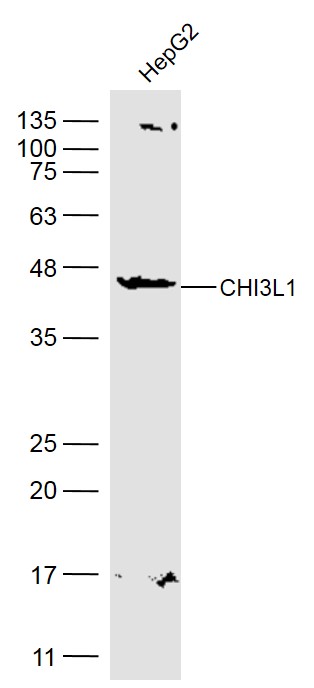
Sample:
HepG2(Human) Cell Lysate at 30 ug
Primary: Anti-CHI3L1 (bs-10215R) at 1/500 dilution
Secondary: IRDye800CW Goat Anti-Rabbit IgG at 1/20000 dilution
Predicted band size: 42 kD
Observed band size: 42 kD
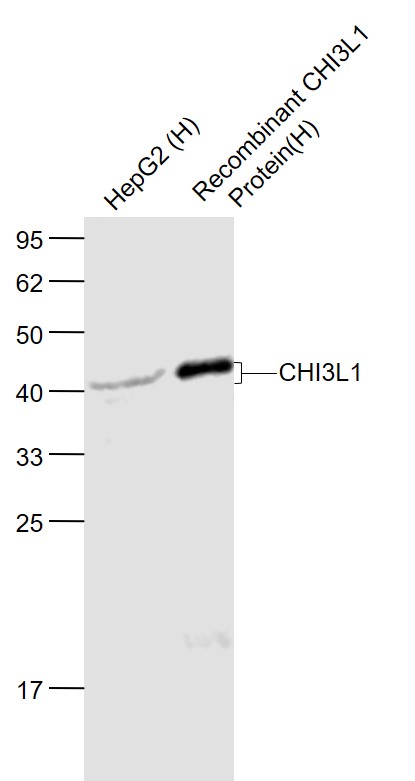
Sample: HepG2 (Human) Cell Lysate at 30 ug Recombinant human CHI3L1 Protein (bs-41221P) at 2 ug Primary: Anti-CHI3L1 (bs-10215R) at 1/1000 dilution Secondary: IRDye800CW Goat Anti-Rabbit IgG at 1/20000 dilution Predicted band size: 42 kD Observed band size: 42 kD
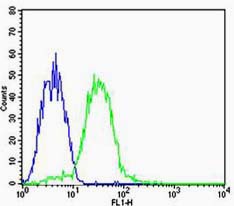
Cell: HepG2
Concentration:1:100
Host/Isotype:Rabbit/IgG
Flow cytometric analysis of Rabbit IgG isotype control (Cat#: bs-10215R) on HepG2(green) compared with control in the absence of primary antibody (blue) followed by Alexa Fluor 488-conjugated goat anti-rabbit IgG(H+L) secondary antibody .
|
| 1、抗体溶解方法 | |
| 2、抗体修复方式 | |
| 3、常用试剂的配制 | |
| 4、免疫组化操作步骤 | |
| 5、免疫组化问题解答 | |
| 6、Western Blotting 操作步骤 | |
| 7、Western Blotting 问题解答 | |
| 8、关于肽链的设计 | |
| 9、多肽的溶解与保存 | |
| 10、酶标抗体效价测定程序 | |