

| 产品编号 | bs-12582R |
| 英文名称 | beta B1 Crystallin Rabbit pAb |
| 中文名称 | β晶体蛋白B1抗体 |
| 别 名 | CRBB1_HUMAN; CRYBB1; Beta-B1 crystallin; CATCN3; CTRCT17; |
| 研究领域 | 细胞生物 神经生物学 |
| 抗体来源 | Rabbit |
| 克隆类型 | Polyclonal |
| 克 隆 号 | |
| 交叉反应 | Rat (predicted: Human,Mouse,Rabbit,Pig,Sheep,Dog) |
| 产品应用 | IHC-P=1:100-500,IHC-F=1:100-500,IF=1:100-500
not yet tested in other applications. optimal dilutions/concentrations should be determined by the end user. |
| 理论分子量 | 28 kDa |
| 细胞定位 | 细胞核 细胞浆 |
| 性 状 | Liquid |
| 浓 度 | 1mg/ml |
| 免 疫 原 | KLH conjugated synthetic peptide derived from human beta B1 Crystallin: 101-200/252 |
| 亚 型 | IgG |
| 纯化方法 | affinity purified by Protein A |
| 缓 冲 液 | 0.01M TBS (pH7.4) with 1% BSA, 0.02% Proclin300 and 50% Glycerol. |
| 保存条件 | Shipped at 4℃. Store at -20℃ for one year. Avoid repeated freeze/thaw cycles. |
| 注意事项 | This product as supplied is intended for research use only, not for use in human, therapeutic or diagnostic applications. |
| PubMed | PubMed |
| 产品介绍 |
Crystallins are the major proteins of the vertebrate eye lens, where they maintain the transparency and refractive index of the lens. Crystallins are divided into Alpha, Beta, and Gamma families, and the Beta- and Gamma-crystallins also comprise a superfamily. Crystallins usually contain seven distinctive protein regions, including four homologous motifs, a connecting peptide, and N- and C-terminal extensions. Beta-crystallins constitute the major lens structural proteins, and they associate into dimers, tetramers, and higher order aggregates. The Beta-crystallin subfamily is composed of several gene products, including Beta A1-, Beta A2-, Beta A3-, Beta A4-, Beta B1-, Beta B2- and Beta B3-crystallin. The Beta A1- and Beta A3-crystallin proteins are encoded by a single mRNA. They differ by only 17 amino acids, and Beta A1-crystallin is generated by use of an alternate translation initiation site. Function: Crystallins are the dominant structural components of the vertebrate eye lens. Subunit: Homo/heterodimer, or complexes of higher-order. The structure of beta-crystallin oligomers seems to be stabilized through interactions between the N-terminal arms. Post-translational modifications: Specific cleavages in the N-terminal arm occur during lens maturation and give rise to truncated forms, leading to impaired oligomerization and protein insolubilization. DISEASE: Defects in CRYBB1 are the cause of cataract congenital nuclear autosomal recessive type 3 (CATCN3) [MIM:611544]. A congenital cataract affecting the central nucleus of the eye. Nuclear cataracts are often not highly visually significant. The density of the opacities varies greatly from fine dots to a dense, white and chalk-like, central cataract. The condition is usually bilateral. Nuclear cataracts are often combined with opacified cortical fibers encircling the nuclear opacity, which are referred to as cortical riders. Defects in CRYBB1 are a cause of cataract-microcornea syndrome (CAMIS) [MIM:116150]. An ocular disorder characterized by the association of congenital cataract and microcornea without any other systemic anomaly or dysmorphism. Clinical findings include a corneal diameter inferior to 10 mm in both meridians in an otherwise normal eye, and an inherited cataract, which is most often bilateral posterior polar with opacification in the lens periphery. The cataract progresses to form a total cataract after visual maturity has been achieved, requiring cataract extraction in the first to third decade of life. Microcornea-cataract syndrome can be associated with other rare ocular manifestations, including myopia, iris coloboma, sclerocornea and Peters anomaly. Transmission is in most cases autosomal dominant, but cases of autosomal recessive transmission have recently been described. Similarity: Belongs to the beta/gamma-crystallin family. Contains 4 beta/gamma crystallin 'Greek key' domains. SWISS: P53674 Gene ID: 1414 Database links: Swiss-Prot: P53674 |
| 产品图片 |
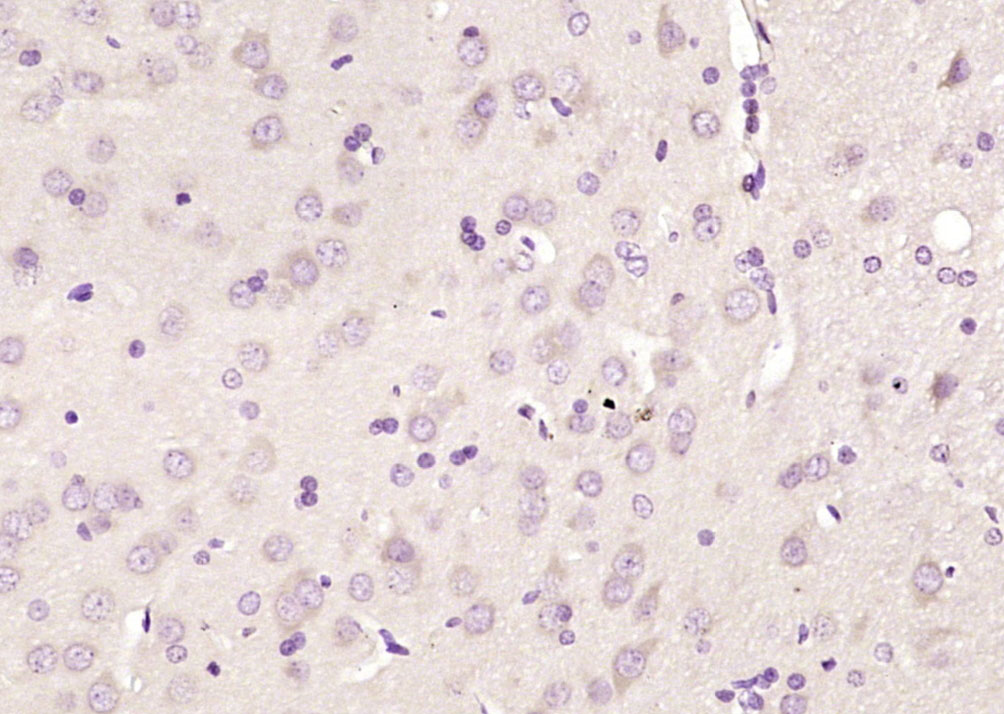
Paraformaldehyde-fixed, paraffin embedded (rat brain); Antigen retrieval by boiling in sodium citrate buffer (pH6.0) for 15min; Block endogenous peroxidase by 3% hydrogen peroxide for 20 minutes; Blocking buffer (normal goat serum) at 37°C for 30min; Antibody incubation with (beta B1 Crystallin) Polyclonal Antibody, Unconjugated (bs-12582R) at 1:200 overnight at 4°C, followed by operating according to SP Kit(Rabbit) (sp-0023) instructionsand DAB staining.
|
| 1、抗体溶解方法 | |
| 2、抗体修复方式 | |
| 3、常用试剂的配制 | |
| 4、免疫组化操作步骤 | |
| 5、免疫组化问题解答 | |
| 6、Western Blotting 操作步骤 | |
| 7、Western Blotting 问题解答 | |
| 8、关于肽链的设计 | |
| 9、多肽的溶解与保存 | |
| 10、酶标抗体效价测定程序 | |