
| 产品编号 | bs-11605R |
| 英文名称 | TULP3 Rabbit pAb |
| 中文名称 | 感光细胞转录因子TULP3抗体 |
| 别 名 | HRCDF; TUBL3; TULP3_HUMAN; TULP3; Tubby-like protein 3; |
| 研究领域 | 细胞生物 神经生物学 信号转导 |
| 抗体来源 | Rabbit |
| 克隆类型 | Polyclonal |
| 克 隆 号 | |
| 交叉反应 | Human (predicted: Mouse,Rat,Chicken,Dog,Horse) |
| 产品应用 | WB=1:500-2000
not yet tested in other applications. optimal dilutions/concentrations should be determined by the end user. |
| 理论分子量 | 50 kDa |
| 检测分子量 | 50 |
| 细胞定位 | 细胞核 细胞浆 细胞膜 分泌型蛋白 |
| 性 状 | Liquid |
| 浓 度 | 1mg/ml |
| 免 疫 原 | KLH conjugated synthetic peptide derived from human TULP3: 251-350/442 |
| 亚 型 | IgG |
| 纯化方法 | affinity purified by Protein A |
| 缓 冲 液 | 0.01M TBS (pH7.4) with 1% BSA, 0.02% Proclin300 and 50% Glycerol. |
| 保存条件 | Shipped at 4℃. Store at -20℃ for one year. Avoid repeated freeze/thaw cycles. |
| 注意事项 | This product as supplied is intended for research use only, not for use in human, therapeutic or diagnostic applications. |
| PubMed | PubMed |
| 产品介绍 |
Mutations in the mouse Tub gene gradually lead to obesity, strongly resembling the late-onset obesity observed in the human population. In addition to excessive deposition of adipose tissue, mice with the Tub phenotype also suffer retinal degeneration and neurosensory hearing loss. A human homolog of the Tub gene has been identified, as have three related proteins, called Tubby-like protein 1 (TULP1), TULP2 and TULP3. When compared to TULP1 and TULP2, TULP3 has a wider tissue expression and is phylogenetically more similar to Tub than either TULP1 or TULP2. TULP1, expressed specifically in the retina, maps to the chromosomal region known to be involved in retinitis pigmentosa, while TULP2 maps within the minimal interval for the rod-cone dystrophy. TULP3 maps to human chromosome 12p13, and shares 69% homology to mouse TULP3. Human RNA from testis, ovary, thyroid and spinal cord contain highly detectable levels of TULP3 transcripts. In the retina, TULP3 is expressed specifically in the inner nuclear layer and ganglion cell layer. TULP1, TULP2 and TULP3 may comprise a unique family of bipartite transcription factors. Function: Negatively regulates SHH signal transduction (By similarity). Probably functions in signal transduction from heterotrimeric G protein-coupled receptors. Binds to phosphorylated inositide lipids. Subcellular Location: Nucleus. Cell membrane. Cell projection, cilium (By similarity). Cytoplasm (By similarity). Secreted (By similarity). Note=Does not have a cleavable signal peptide and is secreted by a non-conventional pathway (By similarity). Translocates from the plasma membrane to the nucleus upon activation of guanine nucleotide-binding protein G(q) subunit alpha. Tissue Specificity: Expressed at high levels in testis, ovaries, thyroid, and spinal chord. Similarity: Belongs to the TUB family. SWISS: O75386 Gene ID: 7289 Database links: Entrez Gene: 7289 Human Omim: 604730 Human SwissProt: O75386 Human Unigene: 655333 Human |
| 产品图片 |
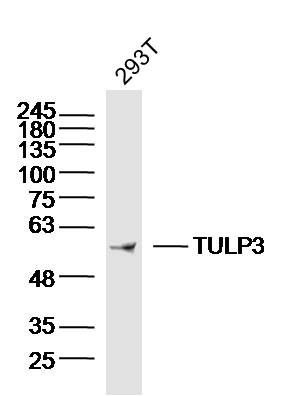
Sample:293T Cell (human) Lysate at 40 ug
Primary: Anti-TULP3(bs-11605R)at 1/300 dilution
Secondary: IRDye800CW Goat Anti-Rabbit IgG at 1/20000 dilution
Predicted band size: 50 kD
Observed band size: 50 kD
|
| 1、抗体溶解方法 | |
| 2、抗体修复方式 | |
| 3、常用试剂的配制 | |
| 4、免疫组化操作步骤 | |
| 5、免疫组化问题解答 | |
| 6、Western Blotting 操作步骤 | |
| 7、Western Blotting 问题解答 | |
| 8、关于肽链的设计 | |
| 9、多肽的溶解与保存 | |
| 10、酶标抗体效价测定程序 | |