

| 产品编号 | bs-1149R |
| 英文名称 | EDA Rabbit pAb |
| 中文名称 | 外胚层发育不良蛋白抗体 |
| 别 名 | EDA_HUMAN; EDA; Ectodermal dysplasia protein (EDA protein); ED1; EDA2; EDA_MOUSE; EDA protein homolog; Tabby protein; Ta; |
 |
Specific References (1) | bs-1149R has been referenced in 1 publications.
[IF=3.3] Oya, Shingo, et al. "Inhibition of Toll-like receptor 4 suppresses liver injury induced by biliary obstruction and subsequent intraportal lipopolysaccharide injection." American Journal of Physiology-Gastrointestinal and Liver Physiology 306.3 (2014): G244-G252. IF(IHC-P) ; Rat.
|
| 研究领域 | 细胞生物 免疫学 信号转导 |
| 抗体来源 | Rabbit |
| 克隆类型 | Polyclonal |
| 克 隆 号 | |
| 交叉反应 | Mouse,Rat (predicted: Human,Cow) |
| 产品应用 | WB=1:500-2000,IHC-P=1:100-500,IHC-F=1:100-500,IF=1:100-500
not yet tested in other applications. optimal dilutions/concentrations should be determined by the end user. |
| 理论分子量 | 24/41 kDa |
| 细胞定位 | 细胞膜 分泌型蛋白 |
| 性 状 | Liquid |
| 浓 度 | 1mg/ml |
| 免 疫 原 | KLH conjugated synthetic peptide derived from human Ectodysplasin-A, secreted form: 131-230/391 <Extracellular> |
| 亚 型 | IgG |
| 纯化方法 | affinity purified by Protein A |
| 缓 冲 液 | 0.01M TBS (pH7.4) with 1% BSA, 0.02% Proclin300 and 50% Glycerol. |
| 保存条件 | Shipped at 4℃. Store at -20℃ for one year. Avoid repeated freeze/thaw cycles. |
| 注意事项 | This product as supplied is intended for research use only, not for use in human, therapeutic or diagnostic applications. |
| PubMed | PubMed |
| 产品介绍 |
The protein encoded by the EDA gene is a type II membrane protein that can be cleaved by furin to produce a secreted form. The encoded protein, which belongs to the tumor necrosis factor family, acts as a homotrimer and may be involved in cell-cell signaling during the development of ectodermal organs. Defects in the EDA gene are a cause of ectodermal dysplasia, anhidrotic, (this is also known as X-linked hypohidrotic ectodermal dysplasia). Several transcript variants encoding many different isoforms have been found for this gene. AltName: ectodermal dysplasia protein; Ectodysplasin-A; EDA protein homolog; Tabby protein; Ectodysplasin-A, membrane form; secreted form EDA-A5. Function: Seems to be involved in epithelial-mesenchymal signaling during morphogenesis of ectodermal organs. Isoform 1 binds only to the receptor EDAR, while isoform 3 binds exclusively to the receptor XEDAR. Subunit: Homotrimer. The homotrimers may then dimerize and form higher-order oligomers. Subcellular Location: Cell membrane; Single-pass type II membrane protein. Ectodysplasin-A, secreted form: Secreted. Tissue Specificity: Not abundant; expressed in specific cell types of ectodermal (but not mesodermal) origin of keratinocytes, hair follicles, sweat glands. Also in adult heart, liver, muscle, pancreas, prostate, fetal liver, uterus, small intestine and umbilical chord. Post-translational modifications: N-glycosylated. Processing by furin produces a secreted form. DISEASE: Ectodermal dysplasia 1, hypohidrotic, X-linked (XHED) [MIM:305100]: A form of ectodermal dysplasia, a heterogeneous group of disorders due to abnormal development of two or more ectodermal structures. Characterized by sparse hair (atrichosis or hypotrichosis), abnormal or missing teeth and the inability to sweat due to the absence of sweat glands. It is the most common form of over 150 clinically distinct ectodermal dysplasias. Note=The disease is caused by mutations affecting the gene represented in this entry. Tooth agenesis selective X-linked 1 (STHAGX1) [MIM:313500]: A form of selective tooth agenesis, a common anomaly characterized by the congenital absence of one or more teeth. Selective tooth agenesis without associated systemic disorders has sometimes been divided into 2 types: oligodontia, defined as agenesis of 6 or more permanent teeth, and hypodontia, defined as agenesis of less than 6 teeth. The number in both cases does not include absence of third molars (wisdom teeth). Note=The disease is caused by mutations affecting the gene represented in this entry. Similarity: Belongs to the tumor necrosis factor family. Contains 1 collagen-like domain. SWISS: Q92838 Gene ID: 1896 Database links: Entrez Gene: 1896 Human Entrez Gene: 13607 Mouse Omim: 300451 Human SwissProt: Q92838 Human SwissProt: O54693 Mouse Unigene: 105407 Human Unigene: 328086 Mouse Unigene: 211298 Rat Ectodermal dysplasia 1属于TNF家族成员, 为常染色体隐性遗传病。 |
| 产品图片 |
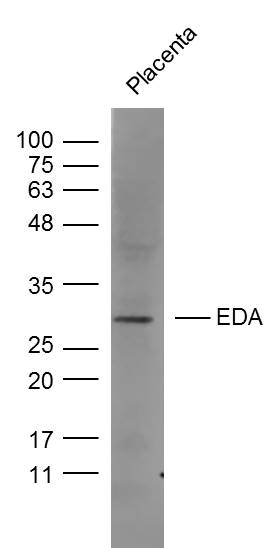
Sample:
Placenta (Mouse) Lysate at 40 ug
Primary: Anti-EDA (bs-1149R) at 1/300 dilution
Secondary: IRDye800CW Goat Anti-Rabbit IgG at 1/20000 dilution
Predicted band size: 24/41 kD
Observed band size: 30 kD
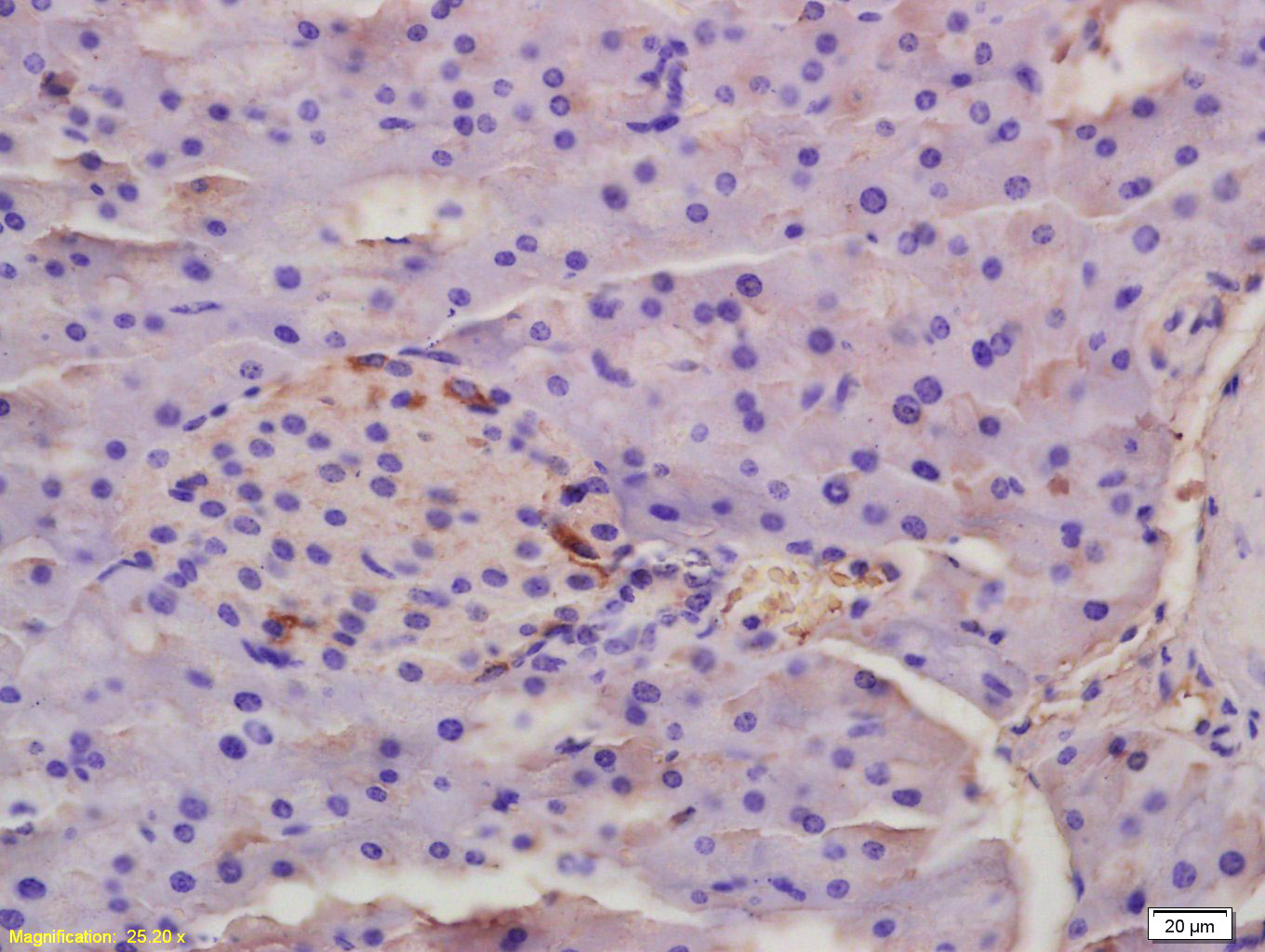
Tissue/cell: rat placenta tissue; 4% Paraformaldehyde-fixed and paraffin-embedded;
Antigen retrieval: citrate buffer ( 0.01M, pH 6.0 ), Boiling bathing for 15min; Block endogenous peroxidase by 3% Hydrogen peroxide for 30min; Blocking buffer (normal goat serum,C-0005) at 37℃ for 20 min;
Incubation: Anti-ED-1 Polyclonal Antibody, Unconjugated(bs-1149R) 1:200, overnight at 4°C, followed by conjugation to the secondary antibody(SP-0023) and DAB(C-0010) staining
|
| 1、抗体溶解方法 | |
| 2、抗体修复方式 | |
| 3、常用试剂的配制 | |
| 4、免疫组化操作步骤 | |
| 5、免疫组化问题解答 | |
| 6、Western Blotting 操作步骤 | |
| 7、Western Blotting 问题解答 | |
| 8、关于肽链的设计 | |
| 9、多肽的溶解与保存 | |
| 10、酶标抗体效价测定程序 | |